
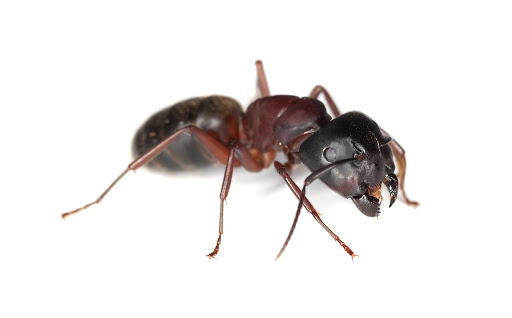
You spotted big black ants trailing across the kitchen floor — or worse, a pile of winged insects on a windowsill — and now you're staring at your phone wondering if your house is being eaten. Take a breath. In Wisconsin, the odds strongly favor carpenter ants over termites, and knowing which one you have changes everything about what happens next.
Both insects damage wood, but they do it in completely different ways, at completely different speeds, and they require completely different treatments. Here's how to tell them apart.
First, the Wisconsin Reality Check
Subterranean termites do exist in Wisconsin, but they're far less common here than in southern states, and infestations cluster in isolated pockets — often in older urban neighborhoods where colonies have persisted for decades. Carpenter ants, on the other hand, are everywhere. They're arguably the most common wood-destroying insect in Dane County and the Milwaukee metro, and they thrive in exactly the conditions our climate creates: moisture-damaged wood around windows, decks, roof edges, and anywhere ice dams have caused leaks.
So if you're seeing large dark ants in your Madison home, carpenter ants are the likely suspect. But "likely" isn't "certain," so let's look at the evidence.
The Insects Themselves: A Side-by-Side Comparison
Body shape
This is the most reliable difference. Carpenter ants have the classic ant silhouette: a pinched, narrow waist between the thorax and abdomen, and elbowed (bent) antennae. Termites have a broad, straight-sided body with no waist at all — they look almost like pale grains of rice with legs — and straight, beaded antennae.
Color and size
Carpenter ants in Wisconsin are usually black or black-and-red, and workers range from about 1/4 to 1/2 inch — noticeably larger than the pavement ants you see on sidewalks. Termite workers are creamy white to pale tan and stay hidden inside wood or soil, so you'll rarely see them in the open unless you break into damaged wood.
Wings (the swarmer test)
Both species send out winged reproductives ("swarmers") in spring. If you find winged insects or shed wings on a windowsill, look closely:
- Carpenter ant swarmers: two pairs of wings of different lengths, front wings longer than back; pinched waist; wings tinted brownish.
- Termite swarmers: two pairs of wings of equal length, roughly twice the body length; no waist; wings milky-clear and shed easily — a pile of identical discarded wings is a classic termite sign.
The Evidence They Leave Behind
Frass vs. mud
Carpenter ants don't eat wood — they excavate it to build nest galleries and kick the debris out. That debris, called frass, looks like coarse sawdust mixed with insect parts, and it accumulates in small cone-shaped piles below nest openings. Finding frass under a window frame, deck joist, or garage door trim is a strong carpenter ant indicator.
Termites actually eat the wood, so they leave no sawdust. Instead, subterranean termites build mud tubes — pencil-width tunnels of soil running up foundation walls, piers, or sill plates that connect their underground colony to your wood. Mud tubes are the single most definitive termite sign.
The wood damage itself
Break open damaged wood and the difference is obvious. Carpenter ant galleries are smooth and clean, almost sanded-looking, and follow the softer grain of the wood. Termite galleries are rough, ragged, packed with dried mud and soil, and often layered like a honeycomb.
Sound and timing
Large carpenter ant colonies produce a faint dry rustling in walls, most noticeable at night. And carpenter ant activity peaks in spring and early summer — if you see big ants indoors in late winter, before anything is active outside, there's almost certainly a nest inside your structure.
Which One Is Worse?
Termites cause damage faster and more silently, and untreated infestations can compromise structural members. Carpenter ants work more slowly, but a mature colony with multiple satellite nests can still do real damage over the years — and their presence almost always points to a moisture problem (leaky roof edge, damp sill, wet deck ledger) that needs fixing anyway. Neither one is a "wait and see" pest.
What to Do Next
- Collect a sample. Trap a few insects in a zip-top bag or take clear photos. Compare against our pest identification guide.
- Don't spray the trail. Over-the-counter sprays kill visible workers but scatter the colony, making professional treatment harder. Carpenter ant control has to reach the nest — often a parent colony outdoors plus satellite nests in the structure.
- Look for moisture. Check for water stains, soft wood, and clogged gutters near where you're seeing activity.
- Get a professional inspection. Distinguishing a satellite carpenter ant nest from termite activity inside a wall isn't a DIY diagnosis. Our ant control service includes locating and treating the nests themselves, not just the trails you can see.
If you're finding big ants, frass piles, or shed wings anywhere in your home, request an inspection. We'll identify exactly what you're dealing with, show you the evidence, and lay out a treatment plan that solves it — whether it's ants, termites, or something else entirely.