Inspection-ready pest control for restaurants and commercial kitchens — discreet, documented, effective.
A restaurant's reputation is built on cleanliness, and it only takes one cockroach crossing the dining room floor — or one photo posted from a booth — to undo years of work. Behind the kitchen doors the stakes are just as real: a priority violation on a public health inspection report, a re-inspection, a franchise or brand audit that comes back with findings, product that has to be thrown out, and in the worst cases a closure ordered by the local health department until the problem is corrected. In food service, pest control isn't a maintenance line item. It is food safety and risk management.
Strib Pest Control builds food service pest control programs for restaurants, bars, cafes, commercial kitchens, caterers, cafeterias and food production spaces. The goal is simple: a kitchen where pests never get established, and a paper trail that proves it when the inspector walks in.
Wisconsin winters don't slow German cockroaches down, because they live entirely indoors. They arrive in cardboard deliveries, used equipment and staff belongings, then settle into the warm, humid voids around dish machines, ice makers, fryer bases and motor housings. They reproduce quickly, so a few sightings can become a serious infestation within weeks. Effective control relies on baits, insect growth regulators and monitoring rather than baseboard spraying — see our cockroach control page for how we approach them.
When temperatures drop in fall, rodents move from dumpster pads, landscaping and sewers into the warmest building nearby — often a kitchen. They enter under back doors, along gas and water line penetrations, and through shared walls in strip centers and older downtown buildings, where a neighbor's rodent problem quickly becomes yours.
House flies peak from late spring through early fall around back doors, patios and dumpsters. Fruit flies follow bars, produce and recycling. Drain flies and phorid flies breed in the organic film inside floor drains and can persist straight through winter.
Indian meal moths and flour and grain beetles ride in on dry goods and spread through dry storage when stock rotation slips.
Our approach follows integrated pest management: find out why pests are present, remove what supports them, and use targeted treatments only where monitoring shows a need. In a working kitchen, that means:
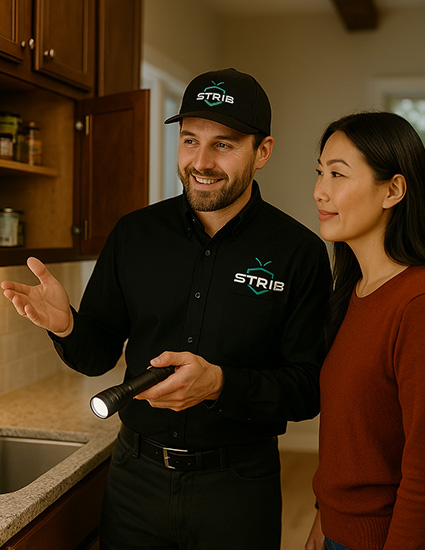
A routine visit typically starts with a quick review of your pest sighting log with the manager on duty. The technician then checks every monitoring point on the map, inspects high-risk zones such as under equipment, drains, dry storage and receiving, treats only where activity is found, and records sanitation or structural issues with clear recommendations. Visits are scheduled before opening, after close or between rushes so your guests never see them. If activity shows up between scheduled visits, call us and we'll come back out for a follow-up.
Each visit produces a digital service report, and trend reporting shows whether activity is rising or falling over time. That record supports local health department inspections, franchise and brand audits, and third-party food safety audits, because it shows active, ongoing control rather than a once-in-a-while spray. For a closer look at what inspectors check and the staff habits that make the biggest difference, read our guide to passing Wisconsin restaurant health inspections.
Strib is headquartered in Madison and serves restaurants and commercial kitchens throughout Madison and Dane County, along the I-94 corridor through Waukesha, Brookfield and Lake Country, and across the Milwaukee metro down the Lake Michigan shore to Racine and Kenosha. Whether you run a single neighborhood restaurant, a hotel or banquet kitchen, or a group of locations, one program and one reporting format can cover every site.
If you have an inspection coming, a fly problem that won't quit, or a provider who sprays the baseboards and leaves without a report, request a free commercial site assessment. We'll walk your kitchen, show you what an inspector would likely flag, and recommend a documented program and service frequency that fits your operation.
No. We schedule around your service hours and design treatments that require no shutdown for routine visits. Where a more intensive treatment is needed, we plan it with you for your slowest window and get you back to full operation fast.
A complete digital service log: findings, materials applied with EPA numbers, device maps, monitoring trends and corrective actions. It is exactly what inspectors and franchise auditors expect to see, current and organized.
Monthly service is the food-service standard, with weekly or biweekly programs for high-pressure sites or fly-prone concepts. We will recommend a frequency after a facility assessment — and adjust it based on what monitoring data actually shows.
Get a documented assessment of your property from a licensed local team.
Office Buildings Schools & Universities Property Management Apartments & Multi-Family Hotels, Resorts & Airbnb Commercial Pest Proofing Warehousing & Storage Municipal & Government Facilities Healthcare Facilities Churches & Places of Worship Stadiums, Arenas & Event Venues