
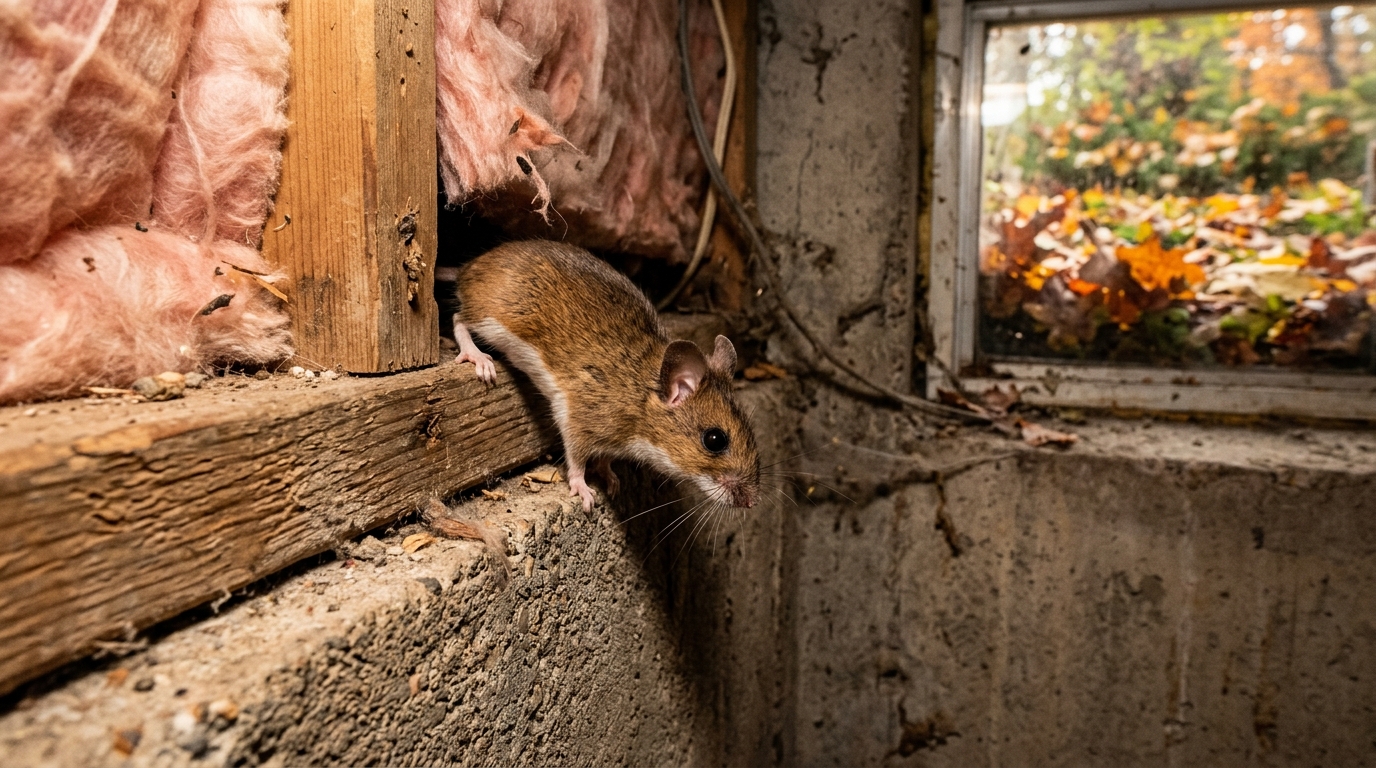
Across southern and southeastern Wisconsin, early October brings crisp autumn air, vibrant foliage, and the first scattered overnight frosts. But as outdoor temperatures plunge into the 30s and 40s, wildlife behavior shifts abruptly. For mice, fields and woodlots that offered abundant shelter and seeds all summer suddenly turn cold and barren — and your furnace-warmed basement, attached garage, and insulated rim joists become the most attractive shelter for miles around.
Every autumn at Strib Pest Control, our service dispatch phones light up with calls from homeowners and commercial property managers from Madison, Sun Prairie, and Verona across to Waukesha, West Allis, and Milwaukee. The story is almost identical: “We haven't seen a mouse all summer, and suddenly we heard scratching in the basement ceiling,” or “We found mouse droppings next to the water heater and in the pantry.”
Understanding why mice target basements and how they exploit microscopic structural gaps is the key to stopping an infestation before winter sets in.
How Fall Weather Triggers the Annual Indoor Mouse Rush
Mice do not hibernate. To survive a harsh Wisconsin winter, house mice (Mus musculus) and deer mice (Peromyscus maniculatus) must find continuous warmth, moisture, and caloric sustenance. As night temperatures drop below 50°F, mice naturally trace thermal updrafts — plumes of warm indoor air leaking from foundation cracks, dryer vent flappers, and basement sill plates.
Because an adult mouse can squeeze through an opening as narrow as one-quarter of an inch (the diameter of an ordinary number-two pencil or a dime), any gap where utility pipes enter concrete, where siding overlaps the foundation wall, or where a garage door rubber gasket has hardened and cracked serves as an open invitation.
The Pencil Test: How Small Is a Mouse Door?
Mice have collapsible ribcages and flexible cartilage skeletons. If you can slide a pencil or the tip of your little finger into a gap around an exterior spigot, basement window well, or AC line set, a young mouse can slip through it in seconds.
The Top Basement Entry Points in Southeast Wisconsin Homes & Facilities
When our technicians perform an on-site IPM inspection, we walk both the exterior perimeter and the interior unfinished basement or crawlspace with high-powered inspection torches. Here are the five most frequent culprits we find:
1. The Sill Plate & Rim Joist Seam
Where your home's wooden framing rests atop the poured concrete or block foundation (the sill plate), settling and wood shrinkage frequently leave continuous gaps. From inside an unfinished basement, mice easily climb up rough concrete or block walls, tuck behind pink fiberglass batting, and nest in the warm rim joist cavity directly beneath your heated living room or kitchen floor.
2. Utility & HVAC Penetrations
Air conditioning refrigerant lines, electrical conduits, natural gas pipes, cable wires, and exterior spigots penetrate basement walls. The original exterior mortar or expanding foam often cracks, deteriorates, or gets gnawed through over time, creating a highway directly into your utility room.
3. Walkout Basement Doors & Window Wells
Basement slider doors, walkout service doors, and ground-level casement windows collect autumn leaves. Rotted door jamb corners or worn rubber door sweeps leave nickel-sized corner gaps where mice step right in from the leaf litter.
4. Attached Garages
Attached garages are the “staging ground” for residential mouse invasions. Vehicles bring in radiant engine heat, garbage cans offer food smells, and garage door bottom seals frequently fail at the bottom outer corners where the rubber meets the concrete jamb. Once inside the garage, mice explore the shared drywall and find plumbing or wiring voids leading straight into the house.
5. Commercial Loading Docks & Overhead Doors
For commercial facilities — such as warehouses along the I-94 corridor, restaurants, grocery stores, and multi-family residential complexes — loading dock levelers and high-traffic overhead doors with damaged brush seals allow rodents direct access to stockrooms and commercial pantries.
Why DIY Poison Boxes Often Cause More Problems Than They Solve
When people discover mice in October, the knee-jerk reaction is often buying poison bait chunks from a big-box store and tossing them into the basement or garage. At Strib, we strongly caution against unmonitored poison boxes for three major reasons:
- Mice Die and Rot Inside Wall Cavities: Poison baits do not make mice “go outside to search for water” (that is an urban myth). Mice die inside wall voids, floor joists, or behind basement drywall, causing unbearable rotting odors that linger for weeks and attract flesh flies.
- Secondary Poisoning Risks for Pets & Wildlife: We frequently speak with homeowners — especially in rural subdivisions around Oregon, Verona, Delafield, and lake properties — who are deeply concerned about neighborhood hawks, owls, foxes, or family pets consuming a poisoned mouse. Anticoagulant rodenticides accumulate in the food chain.
- Poison Does Not Seal the Hole: Killing three mice while leaving the foundation entry gap open simply means three new mice will move in next week to take their place.
The Strib IPM Approach: Permanent Exclusion + Targeted Trapping
Strib Pest Control uses Integrated Pest Management (IPM) — a science-based methodology that emphasizes physical exclusion, sanitation, and targeted indoor mechanical removal:
- Thorough Structural Inspection: We find every active entry point, rub mark (sebum stains), and nesting reservoir from the roofline down to the basement slab.
- Heavy-Duty Rodent Exclusion: We seal gaps using chew-proof materials including galvanized copper mesh, heavy gauge hardware cloth, and professional elastomeric sealants. Unlike expanding foam, rodents cannot chew through metal mesh. Learn more on our residential pest-proofing service page.
- Precision Mechanical Trapping: Inside basements, garages, and attics, we set professional snap traps and tamper-resistant stations placed strictly in rodent runways, safely out of reach of children and pets. This ensures rapid, humane capture without odor risks.
- Follow-Up & Monitoring: We inspect catches, verify that no new activity exists, and ensure your home stays sealed through the deep freeze of January and February.
Commercial Mouse Prevention for Wisconsin Businesses
Rodents in a business setting threaten inventory, health inspection compliance, and brand reputation. For food service kitchens, food manufacturing, office parks, and multi-family housing across Southeast Wisconsin, Strib provides discreet, regulatory-compliant recurring rodent management with full digital logbooks, tamper-proof exterior perimeter baiting, and interior non-chemical monitoring.