
It's the question we hear most from Madison parents, usually right after "how much does it cost" and asked with more feeling: is this stuff safe around my kids and my dog? It deserves a real answer, not a brochure answer. So here's how modern pest control actually works, what the genuine risks are, how they're managed, and the questions you should ask any company you let through your door.
The Short Answer
Professional pest control done correctly — targeted products, applied by licensed technicians, in the right places at label rates — presents very low risk to children and pets. The meaningful risks in real life come from somewhere else: DIY over-application, foggers, and products used contrary to their labels. Emergency calls to poison control involving pesticides overwhelmingly trace back to consumer misuse, not professional service.
That's not a reason to stop asking the question. It's a reason to ask it of every company, and judge them by the quality of the answer.
How Modern Treatment Differs From What You're Picturing
If your mental image of pest control is a technician fogging every baseboard in the house, that's decades out of date. Modern residential work is built on integrated pest management (IPM), which changes the safety math in three ways:
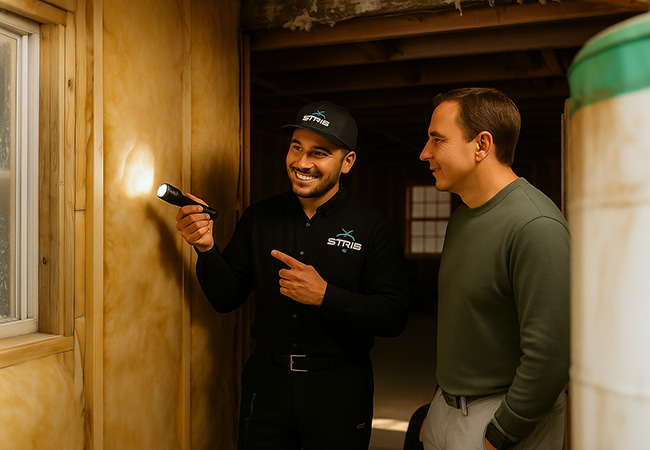
- Less product, placed precisely. IPM starts with inspection: find how pests are getting in and why they're staying. Treatment is then targeted — gel baits in cracks and crevices, dusts inside wall voids, barrier applications along the exterior foundation — rather than broadcast sprays across surfaces your family touches.
- Baits over sprays indoors. For ants and roaches, modern gel baits are placed in tiny amounts in locations kids and pets physically can't reach: behind appliances, inside cabinet hinges, in crack-and-crevice placements. The pest carries the product back to the colony; your countertops never see it.
- Exclusion first. Often the best "treatment" is steel wool, sealant, and a door sweep — zero chemical involved. A company that never mentions sealing entry points is selling you sprays, not solutions.
Every product a licensed Wisconsin applicator uses is EPA-registered, with a label that legally dictates where, how, and at what concentration it can be applied — and those labels are written with children and pets explicitly in mind. "The label is the law" isn't a slogan; it's the actual regulatory framework, enforced in Wisconsin by DATCP.
What "Safe" Looks Like in Practice
Here's the honest operational reality for a typical residential treatment:
- During application: kids and pets stay out of the treated area. For most exterior and crack-and-crevice work, that just means a different room.
- Re-entry time: for standard liquid applications, the guideline is to stay off treated surfaces until dry — typically 1 to 4 hours. Your technician should tell you the specific interval without being asked.
- After drying: treated surfaces present minimal exposure risk under normal contact. Baits in inaccessible placements present essentially none.
Special cases worth flagging to your technician
- Fish tanks: genuinely sensitive — cover tanks and turn off air pumps during any nearby interior treatment.
- Birds: more sensitive to airborne products than cats or dogs; mention them during scheduling.
- Cats: certain pyrethroid concentrations are riskier for cats than dogs, which is one more reason placement and product choice matter — and one more reason to use a professional rather than an off-the-shelf spray.
- Crawling infants: tell your technician. Placements and product choices can and should be adjusted for a floor-level household member.
- Rodent bait stations: if rodenticides are used at all, they belong in locked, tamper-resistant stations placed where children and pets can't access them — and a good company will discuss trap-based alternatives if you prefer.
Questions to Ask Any Pest Control Company
You'll learn everything you need from how a company answers these five:
- "What products are you using, and can I see the labels?" (Confident yes = good sign.)
- "Where exactly will you apply, and why there?"
- "What's the re-entry time for my kids and pets?"
- "Do you practice IPM — will you look for entry points and causes, or just treat?"
- "Do you offer reduced-risk or botanical options?" Our eco-friendly service options exist precisely for families who want the lowest-impact effective approach.
The Risk Nobody Prices In: Not Treating
One more thing parents deserve to hear: untreated pests carry their own health risks for kids. Mouse droppings and cockroach allergens are well-documented asthma triggers in children — roach allergen is a major factor in urban childhood asthma. Wasp stings hospitalize people every summer. The question was never "chemicals vs. no risk"; it's "managed, targeted treatment vs. the pests themselves." Done right, the treatment is by far the smaller risk.
If you've been putting off dealing with ants in the kitchen or mice in the basement because of the kids and the dog — ask us all five questions. Request service and we'll walk you through exactly what we'd use in your home, where it goes, and what we'd solve with a caulk gun instead. You should also ask how our seasonal programs keep most treatment on the outside of the house, where it belongs.