
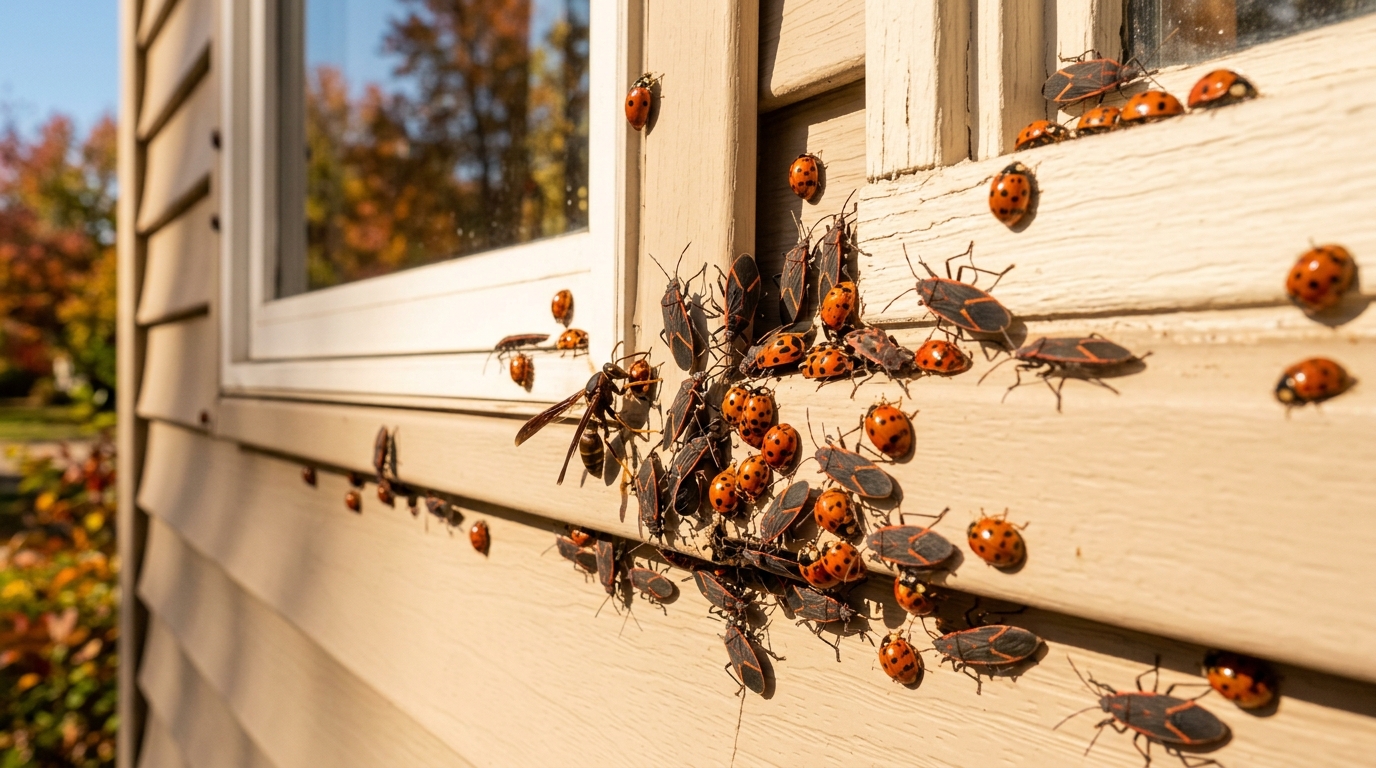
It is one of the most familiar scenes of an autumn afternoon in Wisconsin: following a couple of chilly nights, the sun breaks through, the thermometer climbs into the 60s or low 70s, and suddenly the south- and west-facing exterior walls of your home are practically vibrating with insects. Hundreds of black-and-red box elder bugs cluster on the vinyl trim, orange Asian lady beetles buzz against the window screens, brown stink bugs crawl lazily along fascia boards, and irritable paper wasps and yellow jackets circle under the eaves.
To many homeowners in Madison, Fitchburg, Milwaukee, Brookfield, and Janesville, it feels like an overnight invasion. But these insects aren't congregating randomly — they are taking advantage of Wisconsin's sunny autumn days to complete their critical biological race against winter: finding sheltered voids behind your siding, soffits, and window frames to hibernate.
Understanding their behavior, why your siding is their favorite magnet, and the crucial window of opportunity for prevention can save you from a winter of bugs crawling across your ceilings and light fixtures.
The Physics of the Fall Siding Swarm
Why do they always target the south- and west-facing sides of your house? The reason is simple solar physics:
- Solar Thermal Absorption: As the autumn sun hangs lower in the southern sky, south- and west-facing walls absorb maximum solar radiation throughout the afternoon. Vinyl siding, brick masonry, and dark painted wood can become 15°F to 25°F warmer than the surrounding ambient air.
- Cold-Blooded Thermoregulation: Insects are ectothermic (cold-blooded). On cool autumn mornings, their metabolisms slow to a crawl. By gathering on sun-drenched exterior walls, they absorb radiant heat, warm their flight muscles, and gain the energy needed to locate overwintering harborage before twilight brings freezing temperatures.
- Pheromone Aggregation: Once the first few box elder bugs, Asian lady beetles, or stink bugs land on a prime sunny surface, they release aggregation pheromones that signal to thousands of others in neighboring trees that a safe overwintering shelter has been found.
Meet the 4 Fall Siding Invaders
1. Box Elder Bugs (Boisea trivittata)
Easily identified by their charcoal-black bodies accented with bright red-orange veins on their wings and red eyes. Throughout summer, they feed harmlessly on the seeds of female box elder, maple, and ash trees. In late September and October, adults migrate to man-made structures in swarms. While they don't bite or chew wood, their feces leaves unsightly reddish-orange stains on siding, curtains, and furniture, and crushing them emits a foul, pungent odor.
2. Asian Lady Beetles (Harmonia axyridis)
Introduced decades ago for biological aphid control in agriculture, multi-colored Asian lady beetles look like native ladybugs but are slightly larger, ranging from pale mustard yellow to fiery orange-red, usually bearing an “M” or “W” shaped black marking behind their head. When stressed or crushed, they emit a yellowish chemical called reflex bleeding, which causes severe stains on painted walls and woodwork and releases a sharp, acrid stench. Unlike gentle native ladybugs, Asian beetles can deliver an annoying pinch when landing on bare skin.
3. Brown Marmorated Stink Bugs (Halyomorpha halys)
Shield-shaped, mottled brown insects with alternating black-and-white bands on their antennae and outer abdomen edges. As explained on our stink bug control page, they seek micro-crevices around window frames and rooflines in autumn. When agitated or stepped on indoors, their scent glands release a potent cilantro-and-sulfur defensive odor that lingers for hours.
4. Late-Season Wasps & Fertile Queens
Autumn brings dramatic shifts in wasp behavior. Annual paper wasp and yellow jacket colonies begin collapsing as workers die off. Fertile new queens, however, must find insulated, frost-free voids — like the space beneath siding laps, behind shutters, or inside attic soffits — to hibernate until spring. Meanwhile, surviving late-season workers become aggressive scavengers in search of fermenting tree sap, fallen fruit, or human sweets before the hard frost arrives. See our guide on stinging insect nest removal and prevention.
How They Burrow from Your Siding Into Living Spaces
Many homeowners ask: “If they're on the outside of my siding, how do they end up in my second-floor bedroom in December?”
Vinyl and aluminum siding are designed to hang loosely with weep holes and expansion gaps to allow for thermal movement. Insects slip effortlessly behind the siding slats. Once behind the siding, they follow the house wrap or sheathing seams until they locate:
- Gaps around window and sliding door trim where exterior caulking has dried or cracked.
- Soffit vents, ridge vents, and fascia board gaps leading directly into the attic.
- Utility penetrations like cable entry holes, plumbing vents, and exterior light fixtures.
Once tucked inside wall voids and attic insulation, they enter a state of dormant rest (diapause). But on sunny Wisconsin winter days or when your furnace heats interior wall cavities to 70°F, the insects wake up confused, assume spring has arrived, and crawl toward indoor lighting, emerging through recessed ceiling lights, baseboard gaps, and window jambs.
The Golden Rule: Stop Them on the Outside Before They Enter
Once thousands of overwintering bugs have burrowed into your wall voids, interior aerosol sprays are almost completely useless. In fact, spraying pesticides into wall voids in winter causes thousands of insects to die inside the wall, which attracts secondary carpet beetles and larder beetles that feed on insect carcasses.
The secret to fall pest control is timing:
- Targeted Exterior Barrier Application: In late summer and early autumn (September through early November), our technicians apply an exterior residual barrier to the south- and west-facing siding, eaves, fascia, window perimeters, and foundation. When clustering bugs land on the warm treated surfaces, they absorb the treatment and expire before they can squeeze into voids. Learn more about our outdoor barrier services.
- Exterior Exclusion & Sealing: Seal around window trim, replace damaged vent screening, install tight sweeps on walkout doors, and seal gaps around utility lines using silicone caulk and copper mesh.
- Indoor Management (The Vacuum Rule): If bugs have already slipped indoors, do not crush or swat them. Vacuum them up using a wand attachment, or place a pantyhose or stocking inside the vacuum hose nozzle secured with a rubber band to trap them without scenting your vacuum filter. Then release or discard them outdoors.
Commercial Facility Protection Across Southeast Wisconsin
Overwintering pests are not just a residential headache. Multi-story office buildings with glass-and-brick facades, hotels, senior living facilities, and commercial distribution centers along I-94 and US-12 face significant tenant complaints when swarms of Asian lady beetles and box elder bugs cover entryways and windows. Strib provides customized commercial exterior perimeter applications to keep high-visibility facades clean and pest-free.