
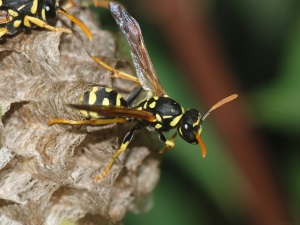
It's a perfect Wisconsin summer evening, you're firing up the grill, and then you see it: a papery gray nest tucked under the deck rail, with wasps sliding in and out of the entrance. Your first instinct is to grab something — a can of spray, a hose, a broom — and deal with it right now.
Please don't. Every August we get calls from Madison-area homeowners who are nursing a dozen stings because a DIY nest removal went sideways. Wasp stings send tens of thousands of Americans to emergency rooms every year, and the difference between a smooth removal and a disaster usually comes down to a few predictable mistakes. Here they are.
First, Know What You're Dealing With
Not all "wasp nests" are the same animal, and the risk level varies enormously:
- Paper wasps: open, umbrella-shaped combs (you can see the cells) under deck rails, eaves, and railings. Colonies are small — a few dozen wasps — and relatively docile unless the nest is disturbed.
- Yellow jackets: enclosed papery nests in wall voids, deck framing, or underground. Colonies run into the thousands by late summer, they defend aggressively, and each wasp can sting repeatedly.
- Bald-faced hornets: the big gray football-shaped nests. Hundreds of large, fast, highly defensive wasps that can remember and target faces. Not a DIY project, full stop.
- Honey bees: if you see fuzzy bees entering a wall or hollow tree, stop — that's a swarm or colony that a local beekeeper may be able to relocate. Don't spray honey bees.
If you're not sure which you have, our pest identification guide has photos, and our stinging insect page covers each species. Identification matters, because a paper wasp mistake costs you two stings and a yellow jacket mistake can cost you forty.
What NOT to Do
Don't knock it down with a broom or a hose
The classic. Knocking down a nest doesn't kill the colony — it creates a cloud of homeless, furious wasps ten feet from your face, and survivors frequently rebuild in the same spot within days. The hose version adds slippery decking to the equation.
Don't seal the hole
If yellow jackets are flying into a gap in your siding or deck framing, caulking or foaming the opening shut is one of the worst possible moves. Trapped yellow jackets don't die quietly — they chew. Sealed-in colonies routinely chew through drywall and emerge inside the house by the hundreds. Never seal an active entrance.
Don't use gasoline, fire, or "hacks"
Pouring gasoline into a ground nest or torching a nest under a wooden deck needs no elaboration: people burn down decks, poison their soil, and still don't kill the colony. Boiling water, shop vacs, and firecrackers all have proud YouTube histories and terrible success rates.
Don't spray from a ladder
Even done "right," spraying a nest provokes defenders. Doing it while balanced on a ladder means your escape route is a controlled fall. Falls-while-fleeing cause worse injuries than the stings themselves.
Don't attack at midday
At midday the colony's foragers are out — you'll treat the nest, miss a third of the wasps, and they'll come home angry. Wasps are all in the nest and sluggish at dusk and dawn, which is when any treatment should happen.
Don't assume you're not allergic
Systemic allergic reactions can develop at any point in life, even if you've been stung before without issue. Multiple stings can trigger serious reactions even in non-allergic adults — and children and pets on the deck have no say in your DIY decision.
What You CAN Do Yourself
We're not here to tell you every wasp requires a professional. A fair rule of thumb:
- Reasonable DIY: a small, exposed paper wasp comb (golf-ball to fist-sized, cells visible, reachable without a ladder) in early summer. Treat at dusk, wear long sleeves, keep a clear exit path, and never stand directly under the nest.
- Call a professional: anything enclosed (wall voids, ground nests, deck framing), anything football-shaped and gray, anything requiring a ladder, any nest bigger than your fist, anyone in the household with a sting allergy — or any nest in late summer, when colonies peak in size and defensiveness.
Prevent Next Year's Nest
Queens scout nesting sites each spring. Make your deck less inviting: seal gaps in deck framing and siding in early spring, knock down small starter nests in May while they're still one queen and a few cells, keep grills clean and garbage lids tight, and consider a spring exterior treatment — the timing covered by our seasonal programs is designed to catch queens before colonies get established.
If there's an active nest on your deck right now — especially yellow jackets or a bald-faced hornet nest — keep everyone away from it and request service. We treat stinging insect nests throughout the Madison and Milwaukee areas with the right equipment and protective gear, and honestly? Watching someone else do this job is deeply satisfying.