Those "pincher bugs" in the mulch — kept outside where they belong.
Earwigs are the dark, flattened insects with pincers on the tail end that Wisconsin homeowners find in mulch beds, under flowerpots and in damp basements. They are moisture pests: after a wet Madison spring, or during a dry stretch when they migrate indoors looking for humidity, they turn up in bathrooms, laundry rooms and window wells almost overnight.
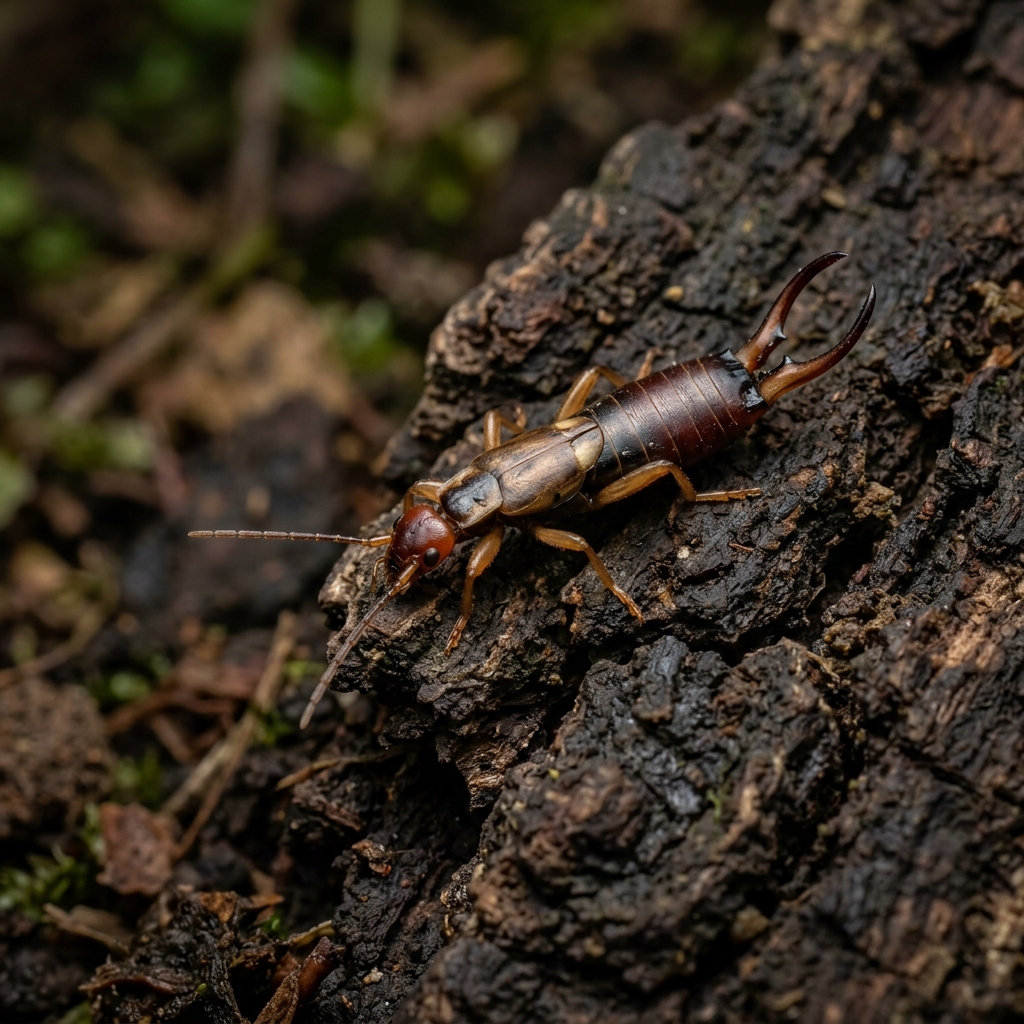
Adults run about half an inch long, reddish-brown, with a pair of curved forceps (cerci) at the rear. Males have thick, curved pincers; females have straighter ones. They are fast, they avoid light, and they are almost always found in groups under something damp — landscape fabric, firewood, siding gaps or leaf litter against the foundation.
Earwigs do not sting, they do not carry disease, and despite the old story they do not crawl into ears. The pincers can deliver a weak nip if you pick one up, but the real damage is to gardens: they chew ragged holes in hostas, dahlias, marigolds and soft fruit, and large indoor numbers are a reliable sign of a moisture problem worth finding.
We treat earwigs where they actually live rather than where you see them. That means a residual perimeter application to the foundation, mulch line, window wells and other harborage, targeted work on damp entry points, and interior treatment only where it is warranted. Because earwigs are moisture-driven, we also flag the drainage, grading and gap issues pulling them toward the house — fixing those is what keeps the problem from returning every June.
No. It is a centuries-old myth with no basis — earwigs have no interest in ears and do not burrow into them. They are simply looking for dark, damp, tight spaces.
Usually a change in moisture. Heavy rain floods their outdoor harborage and pushes them toward the foundation, and a sudden dry spell does the same thing in reverse as they hunt for humidity. Either way, they follow damp gaps inside.
A perimeter treatment knocks the population down quickly, but earwigs breed outdoors in the landscape and keep pressing against the house all season. Homes with heavy mulch beds or persistent moisture do best on a seasonal program.
Earwig control is available across our entire service area at the same pricing and the same response times. That covers Madison and all of Dane County, the I‑94 corridor between Madison and Milwaukee, the full Milwaukee metro — West Allis, Wauwatosa, Franklin, Oak Creek, New Berlin, Muskego and Menomonee Falls — plus Waukesha, Racine, Kenosha, Caledonia, Union Grove and the Janesville–Beloit corridor. No city on this list is an outlying area and none carries a travel fee. Call (773) 263-0887 for earwig extermination in your city.
Fast, honest, guaranteed pest control from Madison to Milwaukee and across southeast Wisconsin.