
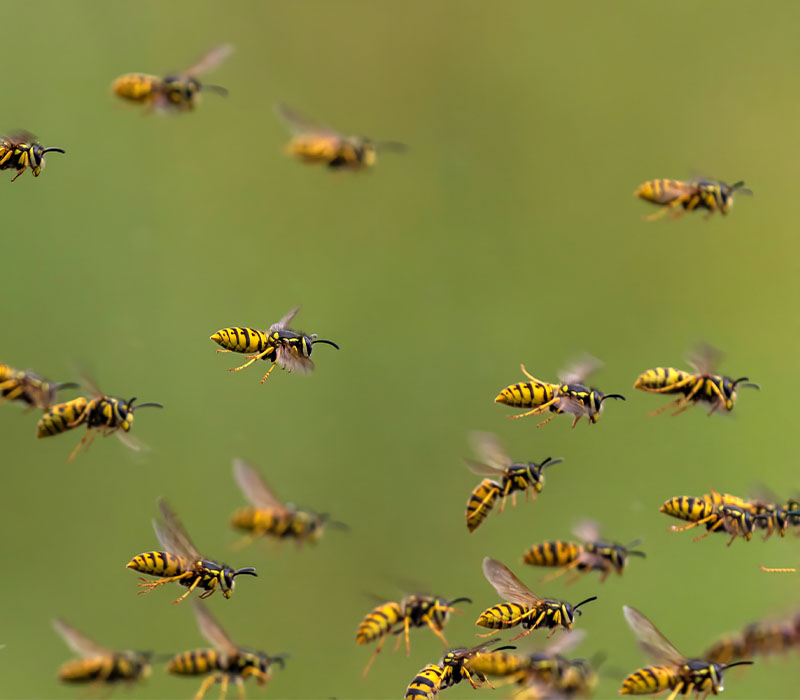
Every year around the first week of August, the phone starts ringing with a very specific kind of call. The nest that has been quietly tucked under the eave since June — the one nobody minded — has suddenly turned mean. Homeowners in Madison, Oak Creek, Kenosha and everywhere between all describe it the same way: they were fine last week.
They were. Here is what changed, and how to tell whether you need bees relocated or wasps eliminated — because those are two completely different jobs, and getting it wrong is expensive.
Why Late Summer Turns Wasps Aggressive
Through spring and early summer, a yellowjacket colony is raising brood. The workers spend their days hunting protein — caterpillars, flies, spiders — to feed developing larvae. In exchange, those larvae secrete a sugary substance the adults feed on. It is a tidy closed loop, and it keeps the workers busy and largely uninterested in you.
In late July and August, the queen stops laying worker eggs. The larvae mature and the sugar supply dries up. Now you have a colony at peak population — a mature ground nest can hold thousands of workers — with nothing to do and a sudden craving for carbohydrates. That is why they show up at your grill, your soda can and your kid's popsicle in August but not in June. They are not more venomous. They are hungrier, more numerous, and far quicker to defend a nest they have spent all summer building.
This runs through late September in southern Wisconsin, and a warm fall stretches it further. It is also why the same nest you walked past for six weeks can put you in urgent care the day you finally mow near it.
Bees or Wasps? Look at Four Things
This matters more than most people realize. Honey bees are pollinators in real decline, and a established colony can be cut out and relocated by a beekeeper rather than killed. Wasps are not relocated — they are eliminated. Before anyone sprays anything, identify what you have.
- The body. Honey bees are fuzzy, amber-brown, and thick-waisted. Yellowjackets are smooth, glossy, bright yellow and black, with a sharply pinched waist. Paper wasps are longer and more slender with dangling legs in flight.
- The nest. Honey bees build waxy vertical combs, usually inside a wall void, chimney or hollow tree, and you will often see staining or hear a steady hum through drywall. Yellowjackets build a papery gray envelope — in the ground, in a wall void, or hanging under a deck. Paper wasps build a small open umbrella comb with visible cells under eaves and railings.
- The traffic pattern. A honey bee colony has heavy, orderly two-way traffic at one entrance all day. Yellowjacket traffic is faster, more erratic, and spikes when you get close.
- The behavior. Honey bees foraging in your flowerbed will ignore you entirely. Yellowjackets investigate you, your food and your drink.
If you are genuinely unsure, do not guess and do not spray. Send a photo from a safe distance and we will tell you which one you have — including whether it is a case for a beekeeper instead of us.
Carpenter Bees Are a Third Category
Those big bumblebee-lookalikes hovering around your deck fascia with the perfectly round half-inch holes beneath them are carpenter bees. The females bore into unfinished softwood to nest; the males hover aggressively but cannot sting at all. They are common on Madison-area decks and on the older wood trim throughout the Milwaukee bungalow belt.
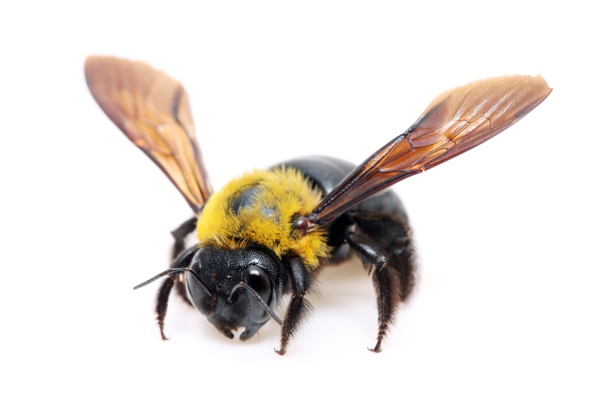
Carpenter bees rarely cause structural failure on their own. The real damage comes later, when woodpeckers hear the larvae and tear the galleries open chasing them, and when the same tunnels get reused and extended year after year. Treatment means dusting the galleries, then sealing and finishing the wood — sealing alone just traps them, and they will chew a new exit.
The DIY Attempts That Send People to Urgent Care
We have written before about what not to do with a nest on your deck, and the same handful of mistakes come up every August:
- Spraying a ground nest at dusk with a flashlight. The light gives them a target, and ground nests have escape tunnels you cannot see.
- Hitting a wall-void nest from outside. Sealing or spraying the exterior entrance drives hundreds of wasps inward through the wall and into the living space. This is the single most common way a nest problem becomes an indoor emergency.
- Using a hose or a bat. Yellowjackets release an alarm pheromone when the nest is disturbed. You are not fighting one wasp.
- Assuming one can of spray reaches the nest. Store-bought aerosol knocks down the workers you can see. The comb, the brood and the queen are usually well past its reach, and the colony rebuilds in days.
If anyone in the household has a known sting allergy, skip all of it and call. That is not a DIY situation at any distance.
What Professional Removal Actually Involves
We locate the nest itself rather than treating where the activity is visible — those are often several feet apart, especially in wall voids and soffits. We treat directly into the nest with equipment that reaches the comb, in gear rated for it. Where the nest is inside a structure we return to remove the comb and seal the entry, because an abandoned nest left in a wall attracts carpet beetles and, in the case of honey bee comb, leaks wax and honey through drywall for years.
Then we deal with next year: the eaves, soffit gaps, railing voids and ground burrows that make your property attractive in the first place. A nest removed in August is a good afternoon. A property that stops recruiting queens each spring is the actual fix, which is what our outdoor and perimeter service is built around.
We Cover the Whole Footprint
Stinging insect calls run on the same schedule and the same pricing across our full service area — Madison and Dane County, the I‑94 corridor, and the entire Milwaukee metro and lakeshore. That includes Milwaukee, West Allis, Wauwatosa, Oak Creek, Franklin, New Berlin, Waukesha, Racine and Kenosha, with no travel fee in any of them.
August and September are our busiest weeks of the year for nest work. If there is a nest you have been walking past since June, this is the month it stops being harmless. See our full wasp, bee and hornet removal page, or request service and we will get out this week.