

It is the middle of January. There is a foot of snow on the ground, nothing has been outside for months — and there is a lady beetle crawling across your kitchen ceiling. Then a slow, clumsy fly bumping against the bedroom window. Then a stink bug on the bathroom mirror.
This confuses a lot of Wisconsin homeowners, and it is one of the most common winter calls we get from both southeast Wisconsin and the Madison area. The short answer: nothing new got in. These insects moved into your walls back in September and October, and a sunny day just woke a few of them up. Here is what is going on, what to expect in spring, and what actually prevents it next year.
The Four Usual Suspects
Several unrelated insects share the same survival strategy: find a protected spot in a building in fall, go dormant through winter, and leave in spring. In our service area, four of them account for nearly all of these calls.
- Boxelder bugs. Flat, half-inch, charcoal black with red-orange edging. They feed on boxelder and maple seeds in summer and cover sunny walls in fall. We wrote about the October swarm in detail in why box elder bugs cover your house every October.
- Asian lady beetles. Round, orange to red, variable spots, and a distinctive black “M” or “W” marking on the white area behind the head. Unlike native lady beetles, they gather on buildings in large numbers, can give a small pinch, and leave a yellow, foul-smelling fluid when disturbed.
- Brown marmorated stink bugs. Shield-shaped, mottled brown, with light bands on the antennae. They have been spreading through Wisconsin and are increasingly common in the Milwaukee metro and along the I‑94 corridor. Disturb one and you will know how it got its name.
- Cluster flies. Slightly larger and slower than a house fly, with golden hairs on the thorax. Their larvae develop in earthworms in lawns, so homes surrounded by turf get them. The adults pack into attics and upper wall voids, which is why they show up sluggish at second-floor windows.
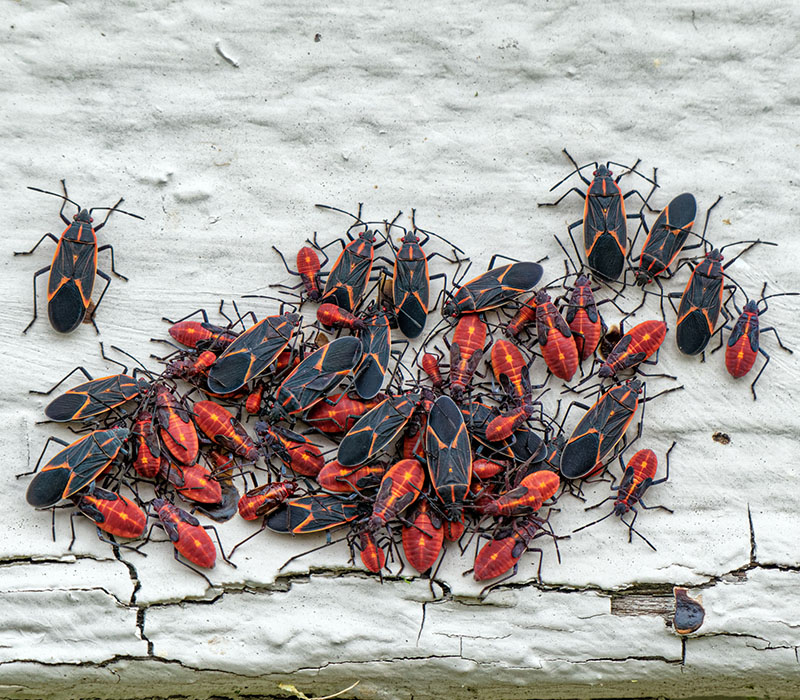
None of these insects breed inside your house, eat your food, damage wood, or carry disease. Their problem is numbers, odor and staining.
Why They Show Up on Sunny Winter Days
Overwintering insects are cold-blooded and take their cues from temperature. Tucked inside a south- or west-facing wall void or a sunny attic, they sit dormant until something warms their spot. A bright January afternoon can heat the sheathing behind your siding well above the outdoor temperature. A furnace flue, a recessed light or a warm attic hatch can do the same thing from the inside.
When they warm up, they move toward light and warmth. Some find their way back outside. The ones that wander the wrong direction come out around window trim, ceiling light fixtures, outlets on exterior walls, baseboards and attic access panels — and end up on your ceiling. Then the weather turns cold again, and they disappear for a few weeks.
What Happens in March and April
Spring is act two, and for many homes it is worse than the fall. As the days lengthen and the walls warm consistently, the entire overwintering population wakes up and tries to leave. Most exit the way they came in, through exterior gaps. But the more of them there are in your walls, the more take a wrong turn into the living space.
That is why a house that had a big fall aggregation often sees a second wave on the inside windows in late March and April. It is not a new infestation. It is the same insects heading out. Once they leave, the problem ends until the next fall.
Why Spraying Indoors Does Not Work
The instinct is to grab a can of bug spray. Here is why it is a losing move:
- You are spraying the few, not the many. The insects on your ceiling are a small fraction of what is inside the walls, where no spray reaches.
- Dead insects in walls create a new problem. Large numbers of dead insects in a wall void can feed carpet beetles and other scavengers, which then work their way into the living space.
- You add insecticide to rooms you live in for a pest that will leave on its own in a few weeks.
What to Do Instead
- Vacuum, do not crush. Crushing boxelder bugs and lady beetles stains walls and fabric, and stink bugs release their odor. Use a shop vac or a vacuum with a disposable bag, and empty it outside. Slipping a knee-high stocking over the hose with a rubber band catches them before they reach the bag.
- Seal interior gaps now. Caulk around window and door trim, gaps at ceiling light fixtures and exhaust fans, and the attic hatch. Add foam gaskets behind outlet and switch covers on exterior walls. This keeps the wall population in the walls.
- Use a light trap in the attic for cluster flies if they are coming down through upstairs fixtures.
- Do not seal the outside in mid-winter. Closing exterior exits while the population is still inside gives them one direction to go — toward you. Exterior sealing belongs in late summer.
Prevention Happens in Late Summer, Not in January
Everything you can do about next winter's bugs happens before they move in. The window for that is late August through September, before the first fall aggregation on sunny walls.
- Exterior sealing. Caulk gaps around window and door frames, siding seams, soffits, fascia, utility penetrations and where siding meets foundation. Repair torn screens on windows, soffit vents and gable vents.
- A properly timed exterior treatment. Applied to the sunny south and west sides, eaves and entry points before insects start gathering, this dramatically reduces how many ever reach your cracks. Timing matters more than product; a treatment after the bugs are already inside does very little.
- Repeat each year. Asian lady beetles and boxelder bugs return to the same buildings season after season, so a home that gets them once will keep getting them until something changes.
The fall visit in our seasonal home protection programs is built around this timing. You can also read our species pages on Asian lady beetles and stink bugs for more detail.
What About Spiders in the Basement?
You may also notice more spiders indoors in winter. Most are cellar spiders and house spiders that live in basements year-round, feeding on whatever small insects are around — including the overwintering ones. They are harmless, and reducing the insect population tends to reduce the spiders too. If they are building up in a finished basement, our spider control page covers what helps.
Set Up Next Year Now
If you are vacuuming lady beetles off the ceiling this winter, put a reminder on your calendar for August. We handle overwintering pests across Madison and Dane County, the I‑94 corridor through Waukesha County and Lake Country, and the full Milwaukee metro and Lake Michigan shore to Racine and Kenosha. Request service to get on the schedule for a late-summer exterior treatment, or to have us inspect where they are getting in.