
Pest control in a hospital, clinic or nursing home looks a lot like pest control anywhere else from the outside: inspections, monitors, exclusion, treatment. Inside, almost every part of it is different. The people in the building may be immunocompromised, recovering from surgery, or living there full-time. Some rooms cannot be entered without coordination with clinical staff. And every product used, every visit made and every pest found becomes part of a record that surveyors may ask to see.
Here is what a healthcare pest program should look like for hospitals, outpatient clinics, assisted living and skilled nursing facilities across southeast Wisconsin and the Madison area — and what to expect from the provider running it.
Why Healthcare Is Different
- Vulnerable occupants. Patients and residents may have weakened immune systems, open wounds, respiratory conditions or limited mobility. A pest that would be a nuisance in an office is a genuine infection-control concern here, and so is any unnecessary pesticide exposure.
- Infection prevention has a say. In a well-run facility, the pest program is not just a facilities contract. Infection prevention should review the approach, the products used in patient areas, and how sightings are reported and escalated.
- Low-impact methods come first. Monitoring, exclusion, sanitation and baits placed in tamper-resistant stations or cracks and crevices are the primary tools. Broadcast spraying has very little place in a patient-care environment.
- Timing matters. Many services need to happen after hours, between procedures or during low-census periods, so the visit does not disrupt care.
This is the core of integrated pest management, and in healthcare it is not optional. It is the only approach that fits the environment.
Sensitive Areas Need a Coordinated Plan
Operating rooms, sterile processing, NICUs, ICUs, pharmacies, isolation rooms and labs should each have a written procedure agreed on by facilities, infection prevention and the pest provider. That plan typically spells out:
- Who must be notified before a technician enters
- What, if anything, can be applied in that space, and what is limited to monitoring only
- Gowning, hand hygiene and other entry requirements
- How a sighting in that area is reported and how fast it is escalated
In practice, many of these spaces are protected by controlling what is around them: sealing penetrations in adjacent mechanical chases, managing drains in nearby support areas, and catching pests in surrounding corridors before they reach the sensitive room.
The Pests That Matter in Healthcare
Flies
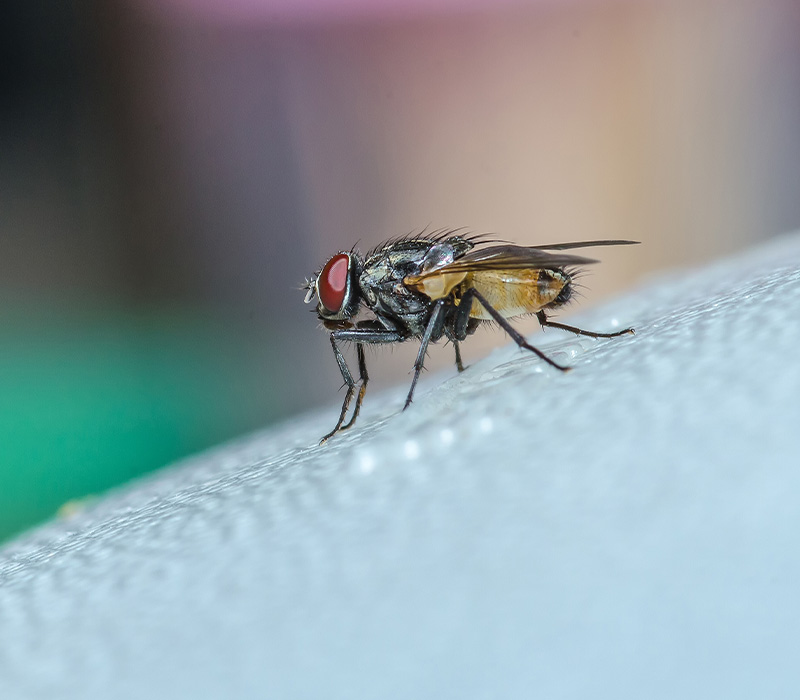
House flies, blow flies, fruit flies, drain flies and phorid flies are among the most important healthcare pests, because flies move between waste, drains and surfaces. Common sources are loading docks, dumpster areas, cafeteria kitchens, floor drains and, in the case of phorid flies, broken drain lines under slabs. Effective control is about finding and eliminating the breeding source, not just catching adults. Our fly control page covers the sources in more detail.
German cockroaches
They concentrate in food service, break rooms, vending areas, nurse station pantries and anywhere warm with moisture and crumbs. Control relies on baits, monitoring and sanitation, not sprays.
Rodents
Mice enter through dock doors, utility tunnels and gaps in older building envelopes, and fall and winter bring the most pressure in Wisconsin. Exterior bait stations and interior monitoring traps, combined with exclusion work, are the standard approach.
Ants
Pharaoh ants are a well-known healthcare pest. They nest in tiny wall voids, travel along plumbing and wiring runs, and are attracted to moisture and sugars. Repellent sprays can cause a colony to split into several, which makes the problem harder, so baiting is the right approach. Other ants show up seasonally around entrances and patient windows in spring.
Bed bugs in senior living
In assisted living and nursing homes, bed bugs can arrive with a new resident's furniture, with visitors, or after a hospital stay. Residents may not notice bites or may not report them, so staff awareness and routine checks matter more here than in most settings. Early detection keeps a single-room issue from becoming a wing-wide one.
Documentation for Surveys and Accreditation
Hospitals accredited by The Joint Commission are evaluated under Environment of Care standards, which expect a safe, functional environment and a managed approach to risks like pests. Nursing homes and assisted living facilities in Wisconsin face state licensing surveys, and nursing homes participating in Medicare and Medicaid are expected to maintain an effective pest control program. In both cases, surveyors may ask to see records, and “we have a contract” is not the same as evidence.
A healthcare pest control binder or electronic portal should include:
- A service agreement and scope describing what is serviced, how often, and the approach used
- A device map showing every numbered monitor, trap and bait station
- Dated service reports for every visit, listing findings, areas serviced and recommendations
- A product list with labels and safety data sheets for anything used on site
- Applicator licensing information showing the people applying products are licensed by the state
- A sighting log where staff record pest activity between visits, with the provider's response noted
- Corrective action records for structural and sanitation issues the provider identified
What a Good Program Report Looks Like
A service report that says “serviced building, no issues” is not a report. A useful one tells facilities and infection prevention exactly what happened and what needs attention:
- Activity by device and location, compared with previous visits
- Trend data showing whether captures are rising or falling in specific zones
- Specific conducive conditions, such as a dock door seal that is torn, a floor drain in the cafeteria with organic buildup, or a gap around a pipe in a basement mechanical room
- Who is responsible for each correction, and whether earlier items were completed
- Any products applied, where and why
That is the level of reporting we build into our healthcare facility pest control programs, because it is what holds up when a surveyor asks.
Serving Healthcare Across Southern Wisconsin
We work with hospitals, clinics, senior living communities and nursing homes across Madison and Dane County, the I‑94 corridor through Waukesha County, and the Milwaukee metro and Lake Michigan shore through Racine and Kenosha. If your facility is preparing for a survey or your current reports would not stand up to one, request a commercial consultation and we will review your program with facilities and infection prevention together.